Sustainability and Efficiency Through Electrochemistry in Chemical Engineering
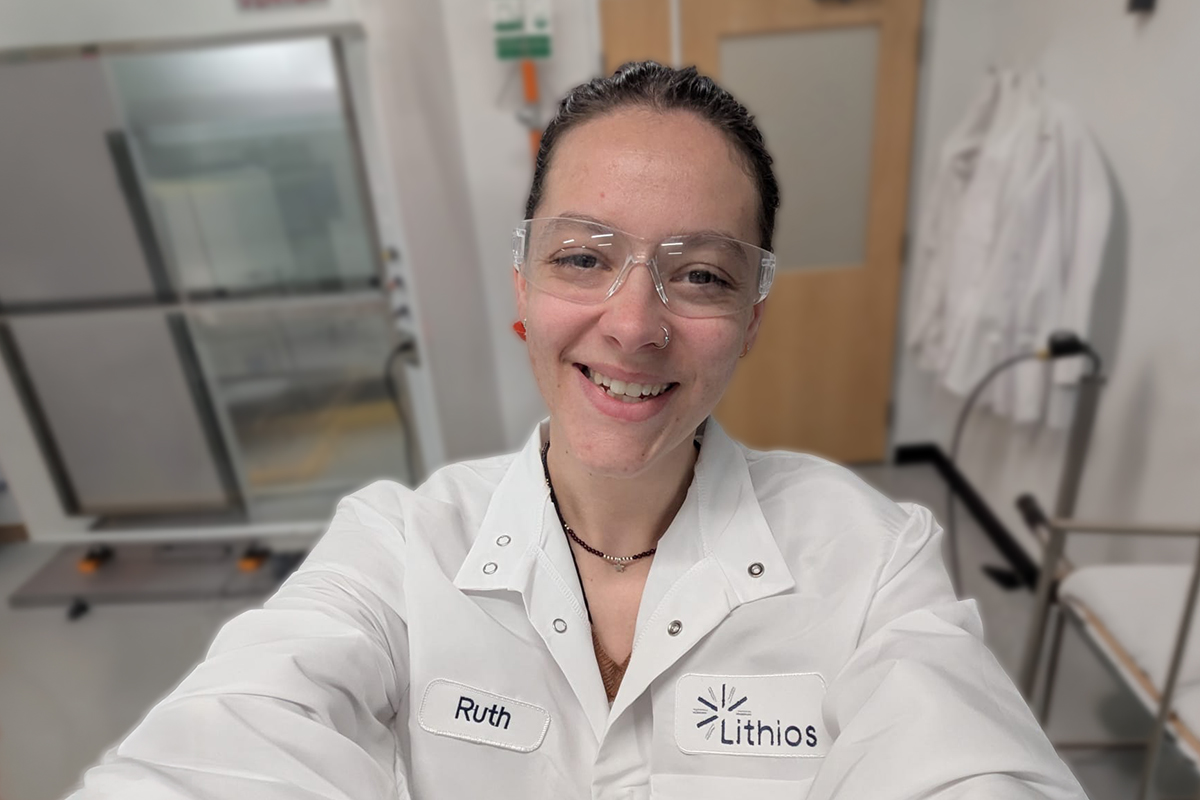
Self-portrait of Ruth Benyo. Courtesy photo.
Ruth Benyo completed her bachelor’s degree last spring in chemical engineering at Northeastern. Chemistry was her favorite subject in high school, and she always knew she wanted a career in the sciences—she just wasn’t sure about the specifics. Benyo entered college undecided, wanting to explore all opportunities, and found that she was drawn to engineering in particular. Combining both interests, chemical engineering felt like a natural fit.
She chose Northeastern for its flexibility. Benyo was drawn to the Explore Program, which gave undecided students the freedom to find their path, and she credits her advisor’s guidance as invaluable throughout that process. Another factor was the Co-op Program, allowing her to “try out” different roles or industries before she commits a career to them. She admired not only the programs themselves, but the university’s flexibility in allowing students to forge their own path, stating that other schools with similar programs are often stricter.
Labs and co-ops
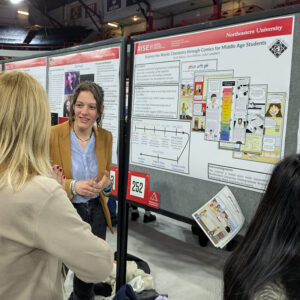
Benyo presenting at the RISE Expo. Courtesy photo.
During her time at Northeastern, Benyo joined two academic labs and completed two co-ops. Her first lab experience was with the Science the World Academic Research Lab, where she wrote and made a comic to teach grade school students about the pH scale—which measures how acidic or basic a substance is. She later presented the project at the RISE Expo, her first time ever presenting research in a poster format. The experience opened her eyes to the importance of science education research—that studying how to teach science is just as valuable as studying the science itself. While a great introduction to academic research, she realized her interests fell more towards the electrochemistry route, and transitioned elsewhere.
This led her to the Galloway Lab. There, she picked up a project started by a previous student, who had been studying how a particular type of battery works. Benyo used an imaging technique called Raman spectroscopy, which allowed her to examine the surface of a battery electrode and see how its chemical makeup changed during use. To do this, she first made a custom holder that would keep the battery in place, then charged and discharged it repeatedly—capturing “before” and “after” images at ten times magnification without losing quality, giving future researchers a clearer window into what happens inside a battery. She came into this lab with almost no background in the field, and left with a strong foundation in electrochemical research and a healthy appreciation for the persistence it takes to keep going when things don’t work. Benyo received PEAK awards for her work in both labs, funding that allowed her to dedicate significant time to research without financial strain, something that ultimately led to progress and innovative work.
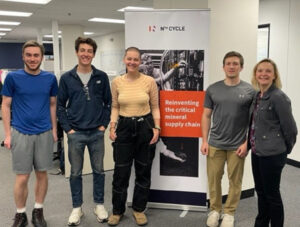
Benyo among her team at Nth Cycle. Courtesy photo.
Her first and most impactful co-op took place at Nth Cycle, a metal refining company that uses electrochemical processes to refine materials like copper and cobalt from batteries and mining waste, and now works on refining Black Mass, a product used in the battery recycling industry. As a chemical engineering co-op, her work centered on commercial scale process optimization––running experiments to help the company produce more material more efficiently. As her first wet lab experience, this co-op was foundational in teaching Benyo basic techniques and laboratory knowledge. Through trial and error, plenty of mistakes, and a lot of questions, she built her confidence and developed real skills in both electrochemistry and process engineering. She credits her team and supervisors for making the experience so meaningful, giving her a lot of responsibility and guidance to grow as a scientist. This, she says, is where she “learned how to be an engineer and work on a team.” She enjoyed the experience so much that she stayed on part-time afterward, continuing to support the team’s work.
Her second co-op was at Lithios, a company that uses a low-cost electrochemical process to extract lithium from saltwater brines. On the research and development team, her main project involved running experiments to improve the design of the company’s lithium extraction cells. Her work eventually produced a more compact cell design that is now used across the entire company. Apart from that, Benyo also tested and analyzed data from various cells, sharpening her ability to communicate technical findings clearly. Her biggest takeaway from this experience was managing several independent projects at once and comprehending new forms of data: a challenging responsibility that ultimately led to a greater self-assurance in her engineering abilities.
Clubs and mentorship
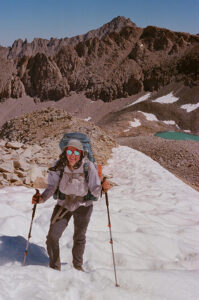
An avid hiker, Benyo joined NUHOC for adventure and community. Courtesy photo.
Outside the lab and classroom, Benyo was involved in two clubs: Northeastern University Huskiers Outdoors Club (NUHOC), and NU & Improv’d Improvisational Comedy Performance Troupe. For the first few years of college, most of her weekends were spent hiking and backpacking in the forests of New Hampshire with NUHOCers. The club gave her a way to get outdoors and connected her with a community of adventurous people, some of whom remain close friends. She later served as the vice president of trips and communications, managing the logistics and welcoming new members into the club. She found it genuinely rewarding to inspire others to get outside, and is now active in their alumni network.
She joined the improv comedy group for the love of performance and the chance to have fun, eventually serving as vice president there as well, running practices, managing social media, and supporting the club president. Benyo credits this group as a community of friends and a great way to be creative. Across both clubs, she chose to stay away from academic clubs, as she wanted to explore and find new interests. She finds it particularly important for engineering students to invest in their creative interests, stating that “there is more to me than solely engineering.”
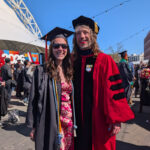
Benyo with one of her research mentors, Professor Luke Landherr. Courtesy photo.
Benyo speaks highly of Northeastern’s chemical engineering faculty, and singles out two professors in particular. The first is COE Distinguished Teaching Professor and Associate Chair for Undergraduate Studies Luke Landherr, who taught Benyo’s Processes Control and Transport 2 classes and supervised her first research experience. She admired their approachability—their open-door office policy and genuine willingness to meet students wherever they are made a real difference. Benyo also credits Associate Professor Joshua Galloway, whom she also researched under. With running such a large lab, Benyo was surprised by how much time he spent with his undergraduate students—something that is unfortunately not always the case. Professor Galloway also pushes his students, setting high expectations that encourage growth, while also always “being willing to teach” and guide his students.
Advice and future plans
Looking back, Benyo offers a simple piece of advice: the team is everything. She explains that in academia students are often led to believe that the science takes precedence over everything else, when in reality it is just as important to like your team and supervisors. Especially in the co-op process, she stresses that “if you do not like your team, you are not going to have a good six months.” Team conflict also takes away from the most important aspect of these experiences––learning as much as you can.
As for what’s next, Benyo is looking to enter the electrochemical industry, with interests ranging from mining and metal refining to aviation fuel and hydrogen fuel cells. She’s keeping an open mind, focused on finding a role where she can keep learning and growing. Graduate school is also on her radar, though she wants to gain more hands-on experience first. What ties all of her interests together is a deep fascination with electrochemistry and a drive to build a more efficient and sustainable world.