Grit, Science, and Good Hands
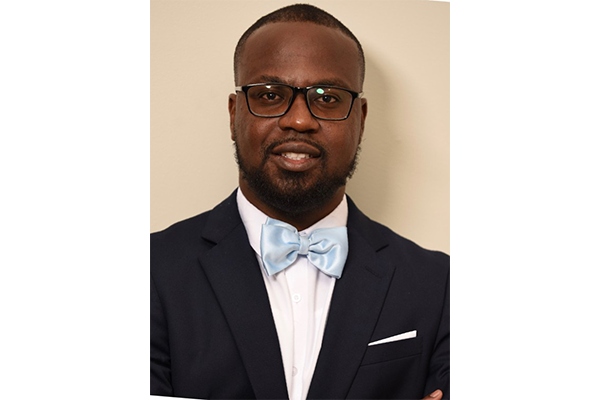
Portrait of Victus Kordorwu. Courtesy photo.
Victus Kordorwu, PhD’26, chemical engineering, is a graduate researcher at the Advanced Drug Delivery Research and Lustig Lab at Northeastern. Driven by grit and a belief in science as a force for human good, he hopes to bridge academic research and industry experience to make an impact in the biopharmaceutical field—in the United States, Ghana, and beyond.
Victus Kordorwu received a PhD in chemical engineering from Northeastern this spring. After he obtained a bachelor’s degree in petroleum engineering from Kwame Nkrumah’ University of Science and Technology in Ghana, he worked at Diamond Cement Ghana Limited as a process engineer. Kordorwu’s interest in chemical engineering was piqued while in this position, inspiring him to pursue a master’s degree in chemical engineering at Dalian University of Technology in China. There, he published his first high impact paper on movement and flow modeling, which led him to an even deeper dive into the field, and ultimately, a PhD.
Kordorwu describes himself as “a life-long learner.” With a strong desire to become an expert in his field and to lead independent research, he knew a PhD was necessary. Further studies would allow him to tackle complex problems, develop independence as a researcher, and build a skill set that would prepare him for impactful roles in his career.
Kordorwu was drawn to Northeastern mainly because of the Co-op Program, for its valuable industry experience. He also admired Northeastern’s R1 status and the robust educational reputation that Massachusetts has, offering him the integrative training he needed to advance his career. He states that “I have been interdisciplinary my whole life,” and believed Northeastern provided “the right setting” to develop his abilities through multidisciplinary research. He adds, “I belong here; it’s a good match.”
Current Research
Kordorwu works as a graduate researcher concurrently for the Advanced Drug Delivery Research (ADDRES) Lab and the Lustig Lab with the goal of improving how well laboratory tests can predict a drug’s performance in the human body. The current lack of reliable connections between lab testing and real patient outcomes suggests that an important part of the digestive environment, which may fundamentally affect how well a drug is absorbed, is being ignored during drug development and selection. This disconnect can lead to unpredictable drug behavior in patients, making treatments less effective, less reliable, and more costly.
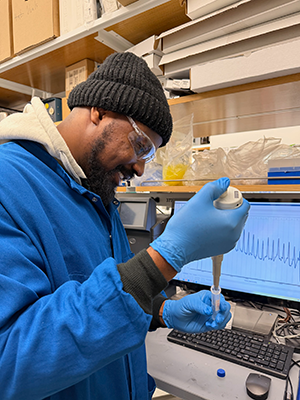
Kordorwu working in the lab. Courtesy photo.
Kordorwu’s research focuses on understanding the role of the digestive tract’s mucus lining in drug absorption, a factor that has long been overlooked. He has shown that this mucus can strongly influence how a drug is absorbed into the body and help explain the inconsistent results seen with some oral medications in real patients. For this reason, he spent significant time studying how drugs and mucus interact at a molecular level. Building on this understanding, he has developed a screening tool that predicts how the mucus and other drug ingredients affect whether a formulation remains stable and effective. This approach reduces trial-and-error, lowers development risk, and improves how drugs are screened and selected, ultimately reducing developmental cost. His work offers transformative guidance for oral drug research, improving the ability to predict real patient outcomes.
Kordorwu has appreciated Northeastern’s support for his research, particularly from within his department. When research funding runs low, the university offers graduate students teaching assistant positions to help bridge the gap—an arrangement Kordorwu has found both practical and rewarding. The training is fully funded and insightful, and the experience of mentoring undergraduate students has helped him develop as a leader along the way.
Academic and mentorship
Kordorwu speaks highly of the course work in his program, particularly for how directly it connects to his daily research. His Thermodynamics and Transport course—taught by his co-advisor, Associate Professor Steve Lustig—is one he returns to constantly, describing it as knowledge he “lives and breathes every day.” He adds: “I am super grateful for the training he gave us.” For Kordorwu, the most challenging coursework has proven the most valuable—exams that required complex derivations by hand built the foundational skills he now relies on in his research.
The most influential mentors in his academic journey are his co-advisors, Distinguished Professor Rebecca Carrier and Professor Lustig—who he describes simply as “the perfect duo.” Professor Lustig’s computational and analytical approach has pushed Kordorwu to master the foundations of his research, guiding him through difficult concepts with patience and consistent encouragement. Professor Carrier brings complementary expertise in gastrointestinal research, biomaterials, and biology, and Kordorwu is equally grateful for her mentorship—crediting her as a source of both academic guidance and emotional support throughout his doctoral journey. Together, he says, “they are super supportive; I cannot thank them enough. I fell into good hands.”
Beyond his coursework, Kordorwu is a member of the Northeastern Graduate Student Union, where he has participated in petitions, meetings, and discussions about the labor rights of graduate students on campus. Through the union, he has found a community of people in a similar position—ones who are willing to take action to improve their conditions while at Northeastern. Outside of academia entirely, Kordorwu is deeply passionate about music. He creates bass tutorials on YouTube to teach and inspire others, and as a music director, he mentors younger musicians and helps build strong musical communities.
Advice and ambition
Kordorwu’s biggest piece of advice to other students is simple: “keep going, even when it’s hard; don’t give up.” It’s a lesson he has lived—learning to back himself even when others didn’t, leaning on grit when the work got difficult. As he puts it, “if you want to do something, believe that you can do it, no matter how hard it is.”
He is also grateful for the practical support Northeastern has offered beyond the lab. A co-op at Takeda Pharmaceuticals gave him valuable industry experience and helped him build a professional network, while the LEADERs program developed his scientific communication and leadership skills in ways that have shaped how he thinks about his career.
Looking ahead, Kordorwu plans spend at least ten years in industry—pursuing opportunities in drug delivery, formulation and consulting roles—before ultimately returning to academia as a professor. He believes that the most impactful educators are those who have worked in the field they teach, and he wants to become one of them. “They have lived the discipline,” he says, “and I saw the difference in their teaching.” His long-term goal is to mentor students the way he himself has been mentored—to be, as he puts it, the “good hands” that they fall into.
Driven by curiosity, perseverance, and a deep belief in science as a force for human good, Kordorwu hopes to leave his mark on the biopharmaceutical field—in the United States, in Ghana, and wherever his work take him.