Cutting Costs for Biofuel by Combining Opposing Microbes to Optimize Manufacturing
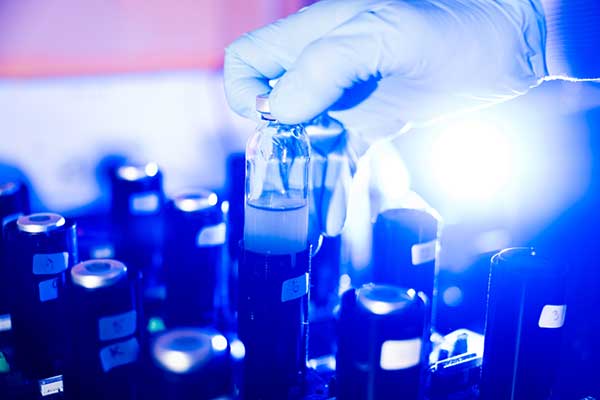
The Woolston Lab was recently awarded funding from the U.S. Department of Energy for the project. Photo by Alyssa Stone/Northeastern University
New research from the Woolston Lab at Northeastern, led by Chemical Engineering Assistant Professor Ben Woolston, is optimizing the biofuel manufacturing process by combining different types of microbes. To do this, they are putting them in the same bioreactor with little oxygen, hoping to reduce cost and resource use in the biofuel industry.
This article originally appeared on Northeastern Global News. It was published by Cesareo Contreras.
These microbes don’t always play well together, but the combination could cut cost of biofuel
It’s well understood in microbiology that aerobic microbes and anaerobic microbes don’t always play nice.
Aerobic microbes thrive in oxygen-rich environments, while anaerobic microbes are just the opposite, preferring those with little to no oxygen at all, explained Ben Woolston, a chemical engineering professor at Northeastern University and principal investigator of the Woolston Lab.
Given their differences, they are regularly placed in two separate single-microbe-type bioreactors, environmentally controlled vessels used to cultivate microbes in the development of products like biofuels and pharmaceuticals.
But researchers out of Woolston Lab are trying to flip that practice on its head in an attempt to bring down the costs of the production of biofuel, save energy, and in turn reduce our reliance on fossil fuels, said Woolston.
They have proposed a novel approach that would allow both an anaerobic microbe and an aerobic microbe to grow together in the same bioreactor.
The research project builds off a key discovery made in Woolston’s lab — if the oxygen levels of a bioreactor are set low enough, there should be no issue for anaerobic microbe and aerobic microbe to share the same reactor.
That discovery was made by 2021 Northeastern graduate Anthony Stohr, who worked at Woolston’s lab as an undergraduate.
“The core technology we’re working on here can be summed up by asking the question — can it be that two microbes are better than one?” said Woolston.
For this project, the researchers are interested in converting C1 feedstocks — one-carbon compounds such as carbon dioxide, formic acid and methanol — into high-energy density fuel that could be used for jets and long-haul ships.
Both aerobic and anaerobic microbes play a key role here.
Although they are slowly moving, anaerobic microbes are efficient and are able to capture large amounts of carbon available in the feedstock. Aerobic microbes, on the other hand, are very fast and are able to capture carbon much faster, but don’t pick up as much, he said.
“The idea with this co-culture is can we put both types of these microbes in the same reactor to get the best of both worlds,” he said.
Here’s how the process would work: First the anaerobic microbe takes the C1 feedstocks and converts it to a C2 feedstock – two carbon compounds such as acetate — that is then sent over to the aerobic microbe, which then converts it directly to high-energy-density fuel, Woolston said.
“It’s a symbiosis you could say,” he said. “You have both microbes working together.”
 |
 |
 |
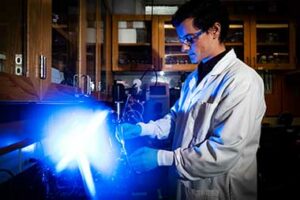 |
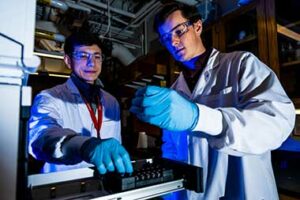
William Gasparrini and Guanyu Zhou, doctoral students in Professor Ben Woolston’s lab, are leading the co-culture project. Photos by Alyssa Stone/Northeastern University
Read Full Article at Northeastern Global News