ChE Research Team Featured on Protein Science Cover
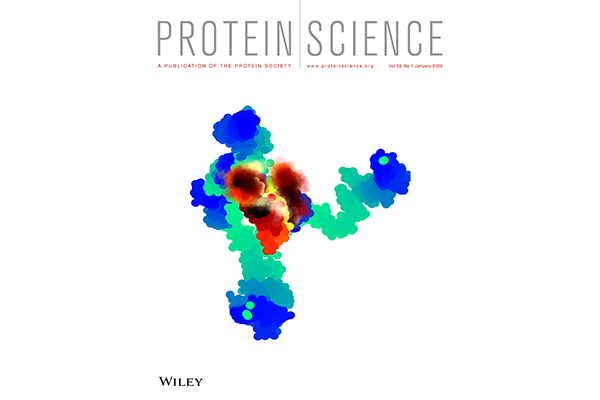
Natesan Mani, PhD’26, chemical engineering, Raghavendran Suresh, MS’23, chemical engineering, and ChE/COS Assistant Professor Srirupa Chakraborty had their research on “Cleaved versus Uncleaved: How furin cleavage reshapes the conformational landscape of SARS-CoV-2 spike” featured on the cover of Protein Science.
Abstract:
The SARS-CoV-2 (spike protein is the primary target for vaccine design, with immunogens typically engineered to enhance stability by introducing proline mutations (2P) and mutating or deleting the furin cleavage site (FCS). While these modifications improve structural integrity, studies suggest that furin cleavage can play a functional role in spike protein dynamics, potentially enhancing ACE2 receptor binding. However, the impact of this cleavage on the unbound form of the spike protein remains unclear. In this study, we use extensive all-atom molecular dynamics simulations to compare the structural and dynamic properties of Cleaved and Uncleaved spike proteins in their prefusion, unbound state. Our results show that furin cleavage significantly alters allosteric communication within the protein, increasing correlated motions within the receptor binding domain (RBD) and N-terminal domain (NTD), which may facilitate receptor engagement. Principal component analysis reveals that the Cleaved and Uncleaved spike proteins sample distinct conformational landscapes, with Cleaved systems settling into stable basins more rapidly. In the receptor binding motif accessible conformation, the Cleaved spike samples two distinct tilt states—an inward (toward Closed-like) and an outward (toward Open-like) orientation—suggesting dynamic tuning between immune evasion and receptor accessibility. Additionally, furin cleavage primes the S2 subunit by expanding the base of the central helix, potentially influencing the transition to the post-fusion state. Glycan clustering patterns further suggest an adaptive structural response to cleavage, particularly in the NTD and RBD regions. These findings highlight the potential functional consequences of FCS deletion in immunogen design and underscore the importance of considering the native cleavage state in vaccine and therapeutic development.