A Chemical Engineering PhD Student’s Evolution Through LEADERs
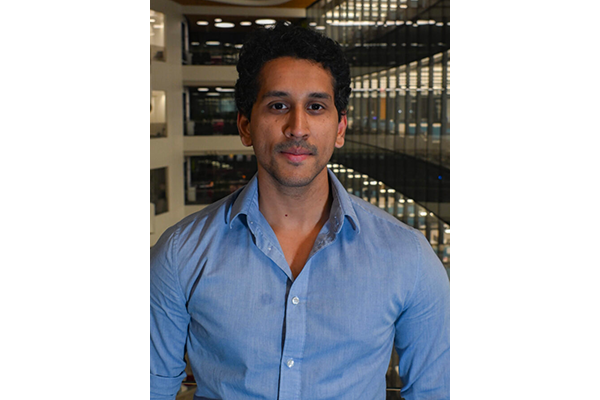
Natesan Mani portrait. Photo credits from Jiajia Fu and the PhD Network.
Natesan Mani, PhD, chemical engineering, reflects on how the courses from the LEADERs Program impacted his professional development, preparing him for his internship at Amgen. These experiences enriched his research skillset and opened doors to opportunities and paths he had never seen before.
For years, Natesan Mani had immersed himself in the specialized world of computational biology, using molecular dynamics simulations to study protein interactions in his chemical engineering PhD program at Northeastern University. His expertise in antigens and antibodies was profound, his research methods sophisticated, and his conversations typically limited to lab mates and conference attendees who shared his technical vocabulary.
Then came the LEADERs emails, “I looked through the topics that they were going to talk about in the course, and I thought it was super interesting. It’s mostly stuff that PhDs don’t really focus a lot on, the leadership aspect, and communicating and presenting your research to a broader audience.” That initial curiosity would launch Natesan on an eight-month placement at Amgen that fundamentally changed not just his career trajectory, but his understanding of what it means to be a scientist in today’s complex world.
Coming Down the Ivory Tower
The LEADERs program at Northeastern University is evidence that bringing PhD students out of their academic comfort zones and placing them into corporate environments creates the opportunities for them to translate their specialized knowledge into real-world impact. For Natesan, the groundwork began in the first LEADERs class, where students from vastly different departments found themselves grappling with the same fundamental challenge: how do you explain what you do to someone who doesn’t share your background? “In the LEADERs cohort, there were people from very different departments. So, it was something I had to think a lot about in the way I present my work.”
Learning to distill complex research into accessible insights was a cross-disciplinary communication skill that proved invaluable during his industry placement. The program’s “PHDL 7600: Leading Self and Others” course covered technical aspects of leadership, business fundamentals (including financial literacy), and critical professional skills like networking and negotiation. As Natesan discovered over the course of the semester, these aren’t skills you can master from textbooks or YouTube videos, “It’s something that you actually have to put yourself in those shoes, and then you do it. A lot of these skills are tough to read off of a page or an article.”
The LEADERS Placement Experience
Natesan’s LEADERs placement at Amgen placed him in unfamiliar territory as the sole computational researcher on a team of experimentalists, “You work in a lab on a topic, and you’re the expert on it. When you communicate your research, it’s mostly to your lab mates or to conferences where people work on similar stuff. But then on the internship, I was put in a team that was completely experimentalists, and I was the only computational guy in there.” The challenge to make his research relevant to colleagues whose daily work looked nothing like his was there, but not insurmountable, “It was hard to communicate my research, but LEADERs [PHDL 7600: Leading Self and Others] really helped me in breaking it down, making it so that everybody could understand what I was talking about.”
Perhaps the most tangible evidence of the LEADERs program’s impact lies in an unexpected development – Natesan’s Amgen manager now serves on his PhD committee. This industry perspective on his academic research represents exactly the kind of cross-discipline application that experiential learning aims to achieve. The experience also provided Natesan with important networking opportunities that extended far beyond his academic team, connecting him with professionals across his field and opening doors to potential career paths he might never have considered. Upon returning to campus from his LEADERs placement at Amgen, he found himself equipped with a new kind of professional confidence, one that made him feel more comfortable going out there and putting himself “in the limelight.”
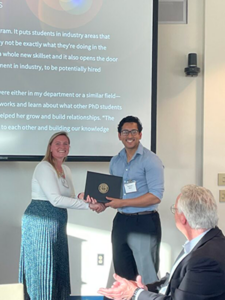
Natesan presenting his experience with the program. Photo credits from Jiajia Fu and The PhD Network.
This newfound confidence drove him to spearhead the establishment of an official Northeastern chapter of the Biophysical Society, complete with programming and events, “I feel like I would not have done it if I had not learned to put myself in the hot seat throughout the course.” The final “Reflection” LEADERs course that Natesan took after his Amgen placement measured not just his acquired skills but also his fundamental shift in self-perception. The program’s spider chart exercise, a self-assessment tool completed at the beginning and end of the LEADERs program, provided tangible evidence of growth, “It was good to see how my placement impacted that spider chart. It was sort of a way for me to tie up, ‘okay, so I started off like this, and then I learned all this, went on an internship,’ so now I feel like all of these skills have improved.”
His advice to other PhD students considering the LEADERs program is unequivocal: “Go for it.” He followed up by emphasizing that success requires active engagement, “You have to be a part of that program, actively attend classes, put yourself outside the comfort zone.” In conversations with graduate students from other institutions across the country, he has found that others are always “super impressed by the emphasis Northeastern gives on experiential learning, actively making its students go out on internships.” Natesan went on to use the research he did at Amgen as part of his dissertation, and he also undertook a separate placement at Genentech, for which the skills and experience learnt during the course and first placement helped him immensely.
Northeastern’s LEADERs program offers a compelling model by combining structured leadership development with intensive industry experience, with which the program addresses a crucial gap in traditional doctoral training. For students like Natesan, the program represents something even more significant – a pathway to professional opportunities that goes beyond technical expertise to encompass the communication, leadership, and networking skills essential for career success. In helping PhD students flourish from narrow specialists into adaptable leaders, LEADERs is unique not just in how it supports PhD students with their future careers, but also in how it expands the vision of what experiential education can achieve.
Visit Natesan Mani’s personal website to learn more: https://natesana.github.io/
Northeast Biophysical Society (NEBPS) link: https://nebps.sites.northeastern.edu
This article originally appeared on PhD Education. It was published by Enryka Christopher.
Photo credits: Jiajia Fu & The PhD Network