Dedication and Passion Creating a Bridge Among Community, Computation, and Chemical Engineering
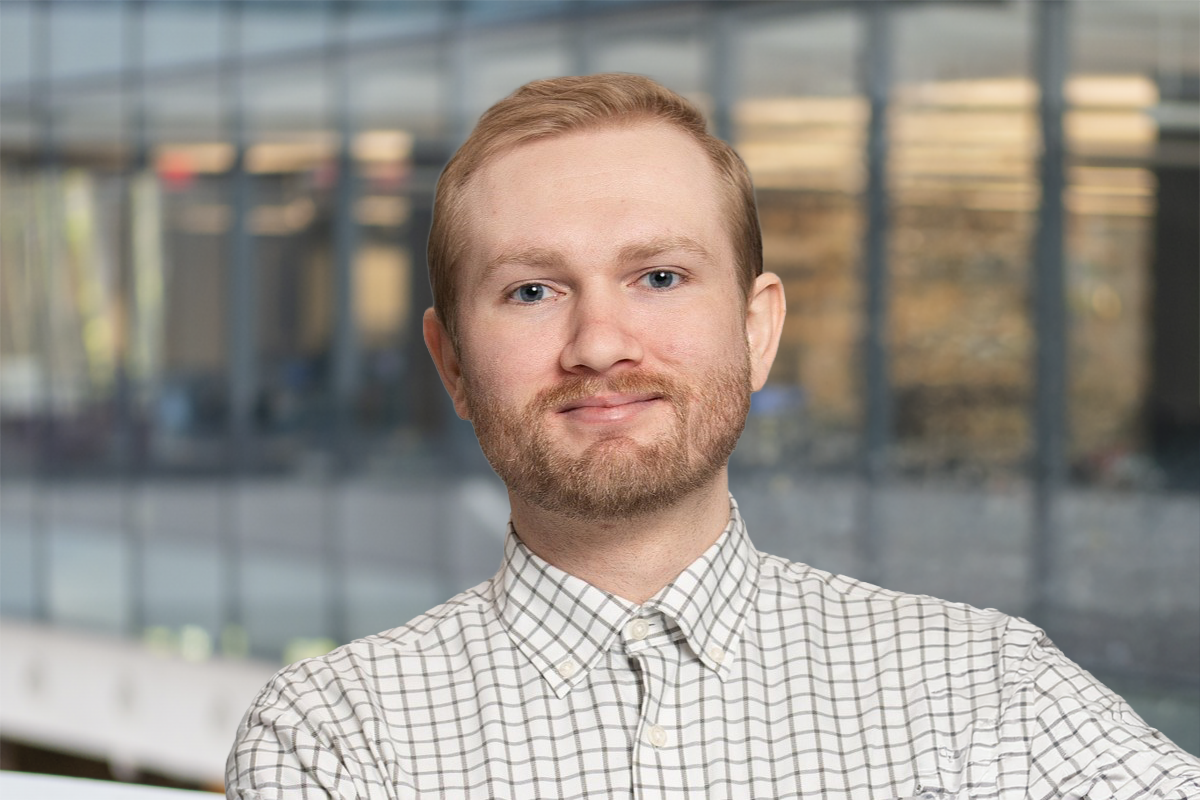
Jason Kantorow, PhD’28, chemical engineering, currently works as a graduate researcher at the SimBioSys Lab and COE Communications Lab at Northeastern. Kantorow has a passion for progress and accessibility within the scientific community and strives to enact this passion through his work as a chemical engineering researcher. Courtesy photo.
Jason Kantorow is currently pursuing a PhD in chemical engineering at Northeastern University. He completed his bachelor’s degree in chemical engineering at the UF Herbert Wertheim College of Engineering. Growing up visiting his father’s molecular genetics laboratory at Florida Atlantic University over summer vacations, Kantorow came to love the science-focused environment offered by research. These experiences led Kantorow to develop an early interest in studying chemistry and molecular biology in middle school, and in high school, he found even greater wonder in the real-world applications of the science he was learning. This led him to engineering, where he participated in numerous projects such as bottle rocket and mousetrap car competitions. Driven towards the overlap among chemistry, biology, and engineering, Kantorow chose to study chemical engineering with a focus on the biopharmaceutical and biomolecular engineering subdisciplines. While Kantorow observed many of his peers intending to join the chemical manufacturing industry immediately after graduation, he noticed that most chemical engineers in his desired field of biotechnology research had PhDs. Wishing to further his abilities in applying chemical engineering principles to next-generation therapies, Kantorow began his search for a chemical engineering graduate program tailored towards biotechnology research.
This interest is what ultimately brought him to Boston and to Northeastern. Despite being the first university he toured, he immediately knew this was his school. Kantorow stated “I immediately fell in love with the city, I fell in love with the campus, and from just that one meeting, I wanted to go here.” Holding a passion for taking the “isolation out of science,” he found that Northeastern not only supported that belief, it also pushed him to engage in opportunities outside of his comfort zone. From there, Kantorow found the SimBioSys Lab where Assistant Professor in Chemical Engineering Srirupa Chakraborty, now his PhD advisor, taught him about how computers are used to design and optimize the structure of medicines and to model biomolecular systems for drug development. This experience combined with his admiration for Northeastern’s R1 status and commitment to student employment after graduation secured his matriculation to Northeastern’s Department of Chemical Engineering as a PhD student.

Kantorow (left) explaining a figure describing his research to an undergraduate (right) at a lab meeting. Courtesy photo.
Research projects and more
Kantorow’s work at the SymBioSys Lab centers around developing novel computational methods for drug delivery system design using materials which experimentation often cannot explore sufficiently. Most of his work centers around glycans—small, branched sugar polymers found ubiquitously throughout the body playing key roles in immune system regulation and cell-cell recognition. While glycan-functionalized drug targeting holds the potential to serve as a safer, more widely biocompatible alternative to targeting methods using antibodies, glycans’ structures are often difficult to study and characterize in vitro. His team is trying to leverage a computer’s ability to model and simulate vast numbers of glycan structures and interactions with receptors on an atomistic level to make up for where experiments lack capability. Glycans are one of the most biocompatible polymers in drug delivery, and using this property along with the most optimal configuration produces safer drug carriers that reduce toxicity and improve drug performance.
Ancillary to his research as a PhD student, Kantorow is also a part of Northeastern’s College of Engineering Communications Lab, where he mentors graduate students across the College of Engineering on how to more effectively communicate their research to all types of audiences. Kantorow takes advantage of his skills in programming to help students automate their data visualization process. In fact, his current Communications Lab passion project has resulted in a workshop he conducts to teach others how to interface with Python through convenient data visualization packages like Matplotlib and Seaborn. This workshop teaches students how to run their data through Python to produce ready-for-publication figures while creating a user-friendly, modular pipeline for generating similar figures easily in the future or quickly outputting documentation on how the data and figures were processed.

Kantorow presenting a 5-minute lightning talk of his research on glycopeptide drug carrier design at the SFB 2024 Northeast Regional conference on Northeastern’s Boston campus. Courtesy photo.
Kantorow continues to effect change in science accessibility through his cofounding the Fully Agentic Drug Engine (FADE). In this endeavor, Kantorow and a couple of peers have built a natural language driven drug discovery pipeline. As an autistic researcher and doctoral student, Kantorow is familiar with how difficulties in communication and isolation can impact the accessibility of many important aspects of science, especially when it comes to learning and using computational tools for molecular modeling and design. Often these tools do not have a user interface and require laborious specialization just to get installed and running. His group is trying to democratize this process by building pipelines and interfaces that lower the barrier for entry to using these tools and give non-computational researchers a leg up on learning how simulation could bolster their scientific process. Kantorow knows from experience that people learn and communicate in different ways and is trying to make the tools he uses for research reflect that belief to create a more welcoming community. FADE is completely open-source and available for anyone to install, and a prepared manuscript is soon to be submitted for peer review.
Wishing to learn early on how his skills in research translate to real-world industrial applications, Kantorow has been a part of the Northeastern LEADERs program for over a year and has since learned many new perspectives through which to view his role as a researcher. The LEADERs course quickly taught him how to articulate his achievements through an “elevator pitch” for future employers. He was then thoroughly informed on how to quantify his value to prospective employers through concrete financial and market-relevant outcomes, giving him confidence in his abilities as a candidate beyond pure technical detail. Kantorow believes that this critical focus on professional development as a PhD student and researcher is vital to industry success upon graduation. Kantorow’s training through the LEADERs program has culminated in a placement at Amgen Inc. where he works with the Advanced Modeling team of the Pivotal AS Biologics department to design more stable and effective antibody drugs through molecular modeling and parallelization of theoretical and experimental data. Kantorow is excited that this experiential learning opportunity has actualized his desire to incorporate biomolecular modeling with core chemical engineering principles, as his work spans across foundational research and process development from the molecular design perspective.
Mentorship and community
Kantorow has found mentorship in many professors at Northeastern. One professor he highlights is Teaching Professor Behrooz Satvat, under whom Kantorow took a core chemical engineering course, while simultaneously serving as a teaching assistant for Professor Satvat’s undergraduate-level transport phenomena course. Kantorow is grateful to Professor Satvat for pushing him to fully commit to the role by having him plan lecture materials and be a strong presence for the undergraduate students. By the end of his time as a T.A., Kantorow had developed his time management and organizational skills, which he uses in his daily research. This experience also gave him confidence as a graduate student, where he was able to master the foundational concepts that he can use for other projects. Kantorow credits Professor Satvat for this confidence, as his unwavering support kept Kantorow going even when his own worries surfaced.
He also credits his P.I., Professor Chakraborty (as well as her entire lab) with creating a positive research environment. In his words, “I feel the best when I know that I am waking up in the morning, getting on the train and going to the lab, because I know I am going to see them.” He calls their lab a “family” because of the community he has found within his research—a community that drives him to continue the sometimes-grueling work of research. Kantorow thanks Professor Chakraborty for establishing an environment of support where everyone in the lab wants their peers to succeed.
Reflection and future plans
Kantorow has found that Northeastern is “one of the friendliest campuses” he has seen, among undergraduates, doctoral students, and faculty alike. Based on that experience, he advises prospective PhD students to prioritize not only the lab and research they hope to do, but also finding people they work well with. Being surrounded by people who contribute to one another’s success has helped him find his niche, and he believes it is one of the most important factors in building a career.

Kantorow receiving a leadership award at ACS Fall 2026 in Chicago. Courtesy photo.
He also sees Northeastern as an excellent place to find community in the Boston area. Kantorow admits he was hesitant to explore at first and wishes he had built that community earlier in his degree. Now, he encourages Northeastern students to take advantage of every opportunity they can, whether social gatherings, networking events, or conferences on campus or around Boston.
Kantorow is grateful for the support Northeastern has given his research. Travel funding allowed him to attend meetings of the American Institute of Chemical Engineers (AIChE) and the American Chemical Society (ACS), giving him platforms to share his work, including projects beyond his dissertation. Those experiences have reinforced his confidence in Northeastern’s commitment to supporting its students both professionally and academically.
Looking ahead, Kantorow hopes to lead research projects in the biopharmaceutical industry while pursuing his passion for making foundational scientific processes more accessible. He sees science and engineering not just as technical disciplines but as a community, one that welcomes others and accommodates different ways of learning and communicating. Wherever he lands, he plans to bring his passion for innovation, community, and accessibility to his career in the biotech industry.